Corporate training programs work best when they address a clear skills gap, use a delivery format that suits the team and include a plan to measure results.
When these elements are missing, training can feel useful in the moment but may have limited impact on how employees work, communicate or perform afterwards.
This article covers the main planning steps, including needs analysis, delivery models, quotation items, training timelines and ways to measure results.
What Are Corporate Training Programs?
Corporate training programs are structured learning sessions that help employees build specific skills, behaviours or knowledge. They can range from half-day workshops to multi-day programmes delivered in-house, off-site, online or in a hybrid format.
Gallup stated that global employee engagement fell to 21% in 2024, costing the world economy an estimated US$438 billion in lost productivity. LinkedIn also reported that 90% of organisations were concerned about employee retention, with learning opportunities ranked as the top retention strategy.
Well-planned training programs can support engagement and retention by giving employees more opportunities to learn and grow.
Employers can also complement skills development with corporate employee wellness programs in Malaysia that support workplace well-being, reduce stress and encourage stronger relationships among colleagues.
Contact My Team Plan to plan a corporate training programme around your team’s skills gaps, learning goals and preferred delivery format.
Start With a Training Needs Analysis
A training needs analysis (TNA) identifies the gap between current and required performance before any course is booked.
It works at three levels, with each level answering a different question.
| Level | Key question | Where to find the answer |
|---|---|---|
| Organisation | Which business goals are at risk this year? | Strategic plan, KPIs, turnover and exit interview data |
| Team | Which teams are missing targets or clashing? | Department KPIs, project post-mortems, manager interviews |
| Individual | Which people need which skills? | Performance reviews, 360-degree feedback, self-assessments |
Turn the findings into one sentence per programme: who needs to do what differently, by when.
“Sales executives in the Penang branch will qualify leads before quoting, by Q2” is a training objective; “improve sales skills” is a wish.
Choose the Right Delivery Model
Delivery model shapes cost, customisation and confidentiality as much as it shapes learning. Match the model to the group size and the sensitivity of the content.
| Delivery model | Best when | Watch out for |
|---|---|---|
| In-house (your premises) | 10 or more staff need the same skill; content uses internal cases | Interruptions from desks and phones |
| Public programme | 1 to 5 staff need a skill; cross-company networking adds value | No customisation; fixed dates |
| Off-site or retreat | Teams need focus, bonding or a reset after change | Venue, transport and accommodation costs |
| Virtual | Staff are spread across states or branches | Screen fatigue; harder to practise skills live |
| Hybrid | A core group meets in person while branches join online | Needs a facilitator skilled at including remote staff |
Most companies in Malaysia use a mix. A common pattern is in-house training for whole departments, public programmes such as the Influence Breakthrough Masterclass for individual high performers, and an off-site session once a year to reset team culture.
Programme Types Beyond Soft Skills
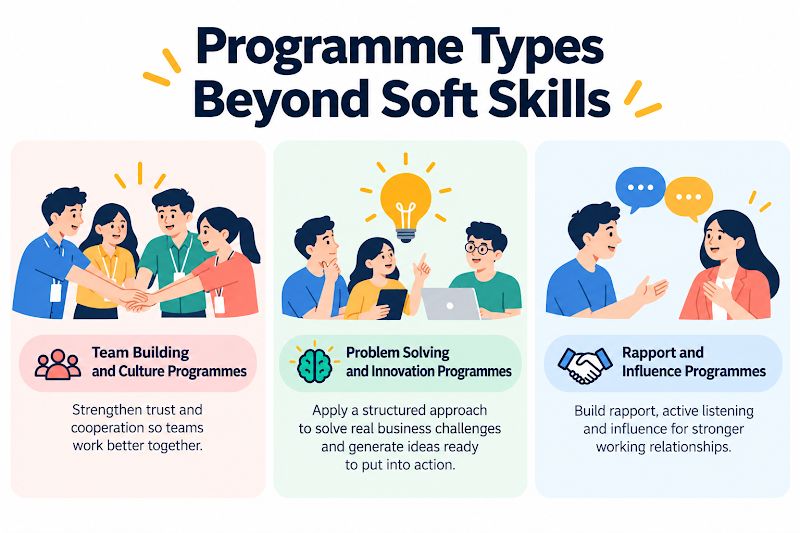
Communication, leadership and sales get most of the attention, yet three other programme types solve problems those courses cannot reach.
Team Building and Culture Programmes
Team building programmes repair trust and cooperation between people who already have the skills but do not work well together.
My Team Plan runs 30+ team building activities across indoor, outdoor, online and hybrid formats, and structured programmes such as Bond to Win pair each challenge with a facilitated debrief that links the activity to daily work.
Problem Solving and Innovation Programmes
Innovation training gives teams a repeatable method for problems that have no obvious answer.
My Team Plan’s Creative Problem Solving & Innovation workshop applies design thinking to your team’s live business challenges, so participants leave with ideas ready to test.
Rapport and Influence Programmes
NLP Training builds rapport, active listening and influence for staff whose results depend on relationships, such as HR business partners, procurement officers and customer service leads.
Unsure which mix fits your team? Book a consultation and My Team Plan will shortlist programmes and delivery models against your needs analysis.
What Goes Into a Corporate Training Quotation
A corporate training quotation should separate every cost so you can compare providers and see which items your funding covers. Ask for these seven line items:
| Line item | What it covers | Question to ask |
|---|---|---|
| Facilitation fee | Lead trainer and co-facilitators per day | How many facilitators for our group size? |
| Customisation | Adapting cases, role plays and activities | Is customisation included or charged separately? |
| Materials | Workbooks, activity kits, certificates | Are materials priced per participant? |
| Venue | Training room or off-site location | Can the session run at our premises instead? |
| Food and beverage | Meals and breaks for participants | Is F&B bundled with the venue? |
| Transport | Travel for trainers or participants | Is travel outside the Klang Valley charged? |
| Follow-up | Post-training reports or refresher sessions | What do we receive after the programme? |
Itemised quotes also make internal approval faster, because finance can see exactly what each ringgit buys.
A 10-Week Planning Timeline
Corporate training runs smoothly when planning starts about 10 weeks before the session.
Work backwards from your training date:
| When | Action |
|---|---|
| Week 10 | Complete the training needs analysis and write programme objectives |
| Week 8 | Shortlist providers and request itemised quotations |
| Week 6 | Confirm provider, date, venue and delivery model; start funding applications |
| Week 4 | Share company context so the provider can customise content |
| Week 1 | Brief participants and their managers on objectives and expectations |
| Training day | Capture attendance, reaction feedback and individual action plans |
| Day 30 and 90 | Review behaviour change and business results with managers |
The Week 1 manager briefing is the step most companies skip, yet participants whose managers set expectations beforehand return to work ready to apply the skills.
Measure Results With the Kirkpatrick Model
The Kirkpatrick Model measures training at four levels: reaction, learning, behaviour and results.
Agree on what you will measure at each level before the programme starts.
| Level | What it measures | How to measure | When |
|---|---|---|---|
| 1. Reaction | Did participants find it engaging and relevant? | Feedback form | End of session |
| 2. Learning | Did they gain the skill or knowledge? | Quiz, demonstration, role play | End of session |
| 3. Behaviour | Are they using it at work? | Manager observation, 360 feedback | 30 to 90 days |
| 4. Results | Did business numbers move? | KPIs such as sales, turnover, error rates | 3 to 6 months |
Levels 3 and 4 matter most to management. Pick one KPI per programme from your needs analysis and track it from a baseline taken before training.
Why Malaysian Companies Choose My Team Plan for Corporate Training
My Team Plan combines team building, skills training and event logistics under one partner, backed by more than 8 years of experience and over 250 successful corporate events across Malaysia.
- One partner for culture and capability: 30+ team building activities and HRD Corp claimable training programmes, planned as one calendar.
- Every delivery model covered: in-house, off-site, online and hybrid sessions, plus public programmes for individual staff.
- Programmes built from your needs analysis: facilitators adapt activities, cases and debriefs to your objectives, team size and industry.
- Trusted across sectors: organisations from mining group BHP to luxury beauty brand YSL have run team programmes with My Team Plan.
Explore HRDF claimable team building and the full list of HRDF claimable training programs
Plan Corporate Training That Delivers Results
Corporate training works best when it starts with clear needs, uses the right format and includes a way to measure results.
My Team Plan combines customised team building and skills training in one programme, backed by more than 250 successful corporate events across Malaysia.
Book a consultation with My Team Plan today to build your next training plan.
Frequently Asked Questions About Corporate Training Programs
1. What is a training needs analysis?
A training needs analysis identifies skill gaps, and My Team Plan uses the findings to recommend suitable programmes and delivery formats.
2. Is in-house or public training better for our company?
My Team Plan recommends in-house training for larger teams needing customisation, while public programmes suit individual employees or smaller groups.
3. Can corporate training be held at our office or online?
Yes, My Team Plan can run training at your office, external venues, online or in a hybrid format.
4. Can team building and skills training run in the same programme?
Yes, My Team Plan can combine skills workshops with selected team building activities in one programme.
5. What should a corporate training quotation include?
My Team Plan quotations can include facilitation, customisation, materials, venue, food, transport and follow-up support.
6. Does My Team Plan run training outside the Klang Valley?
Yes, My Team Plan delivers corporate training and team building programmes across Malaysia.